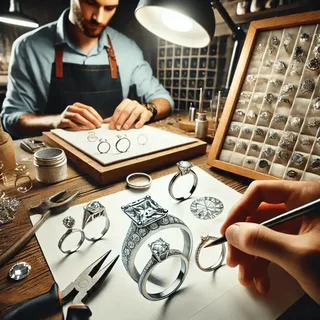
The procedures involved in jewellery may vary based on the design and materials. All shaping, forming, assembling, setting, polishing, texturing and finishing has to be done with care. Even little errors may make a difference in how the end work looks.
Custom designs may demand considerably more care since they might feature distinctive aspects that are not part of standard manufacturing. Artisans have to know the aesthetic desired, and that each aspect is correctly accomplished.
The Custom Jewelry Manufacturers process from design to final product at Mangla International is an essential aspect of craftsmanship. We want to maintain the spirit of the customer’s idea, but pay attention to the little details that make it high quality and beautiful.
From Idea to Prototype
When a design is talked through and agreed in principle it has to progress from idea to actual development. Prototyping is one of the most crucial phases as it gives a chance to test the way the design operates as a real piece of jewellery.
A prototype may show features that you can’t see in a design or computer rendering. You may check the proportions, look at the measurements, inspect the ornamental features and compare the overall look with your original idea.
A real sample may also simplify the decision-making process for a jewellery company. The buyer may decide whether the item has the visual effect they want, if the details are in harmony and if any adjustments need to be made before wholesale manufacturing starts.
Custom jewellery often goes through a number of refinements. Perhaps a piece needs adjustment, a surface needs a new polish, or proportions need to be changed. These choices may be made at the prototype stage to assist minimise issues when mass production starts.
The authorised sample is ultimately a significant production reference. It defines the features of the final product and what it should look like. The approved design might serve as a baseline for the production team to maintain uniformity while producing in higher volumes.
Prototyping is also the place where creativity meets pragmatism. The designer can be thinking about a very precise visual idea, but the producer has to be thinking about how to create that notion efficiently and reproducibly. The prototype builds a bridge between these two views.
This procedure adds another level of assurance for wholesale customers. Rather than going immediately from a drawing to a major order, the firm may first have a physical representation of the design to see how it looks. This is especially important when introducing a new collection or building a distinctive range.
When the same design is produced in big numbers the craftsmanship becomes even more crucial. Wholesale customers want their orders to be uniform. Each item should be consistent with the same general design language, finish and quality.
This involves a mix of excellent labour and well-ordered manufacturing. Experience gives craftspeople a means to observe tiny discrepancies and to correct them in the production process.
The personal touch of crafting is part of the nature of bespoke jewellery, too. Today’s tools may enhance accuracy and speed, but it takes seasoned pros to use critical thinking to grasp innovative thoughts and manage complex details.
This combination of contemporary production processes and ancient workmanship enables personalised jewellery to be both precise and personal.
Materials and Finishing Make Designs a Reality
The design of a jewellery piece is not independent of its materials. The coatings, textures and other components used, together with the metal and the gemstones, may have a great effect on the overall appearance and feel.
When creating a bespoke collection, material selection should thus be addressed in the design process. Various materials may provide diverse visual effects, weights, colours, textures and sensations.
This is a chance for jewellery companies to build collections with unique features. A single design idea may be modified in a number of versions using various finishes, colours, stones or proportions, while yet retaining a recognisable character.
Finishing may also make enormous variances between comparable designs. Glossy finish may offer a luxury and polished impression while brushed or textured finish might provide a more subtle appearance. Mixing finishes may provide contrast and bring out details.
Gemstones and ornamental accents may also affect the nature of a piece. Their location, colour, form and proportion may be signature elements of a collection.
A bespoke jewellery maker must comprehend these possibilities from a manufacturing standpoint. The choice of material may affect the techniques of manufacture, the needs for finishing, the durability concerns, and the overall production planning. “Having these conversations early on enables brands to make informed decisions.
The goal for wholesale buyers is frequently to strike the correct mix between aesthetic appeal and business viability. A beautiful design should operate within the brand’s desired market and price positioning.
There is more scope to investigate the potential of custom production. Instead of being limited to pre-designed and pre-defined offerings, companies may create offerings around their own creative and business needs.
Maintaining Quality in Large-Scale Production
Sample making of One piece Jewellery is distinct from making a whole wholesale order. And as the volume rises, keeping consistency is a high concern.
Quality assurance must be included at an early point in the production process. Materials and components must be according to approved specifications and manufacturing procedures must be according to the standards stated in design and sampling.
The authorised prototype provides a good reference for this procedure. It establishes a visual and technical standard by which production works may be judged. Review dimensions, design details, finishes, stone placement, construction, and overall look to ensure consistency.
Inspection is especially vital for bespoke jewellery as each collection may have distinct needs. A producer cannot just use a generic manufacturing checklist. The expectations of the quality should relate to the unique design which is made.
Also careful attention is needed in finishing. Surfaces should seem as if they are supposed to; ornamental features should be well done; parts should fit well together. Moreover, functional aspects should be addressed since jewellery should be pleasant and practical to wear.
Wholesale clients need consistency since their items are being offered to consumers as their brand. Inconsistencies between items may impact client satisfaction and the overall impression of the collection.
Summary
An organised manufacturing process may cut such anomalies. The manufacturer will be working toward a uniformity throughout the order, standardising design standards, authorised samples, manufacturing techniques and quality checks.
Reliable Custom Jewelry Manufacturers quality might be the key to a successful long-term manufacturing partnership for a developing jewellery firm.