

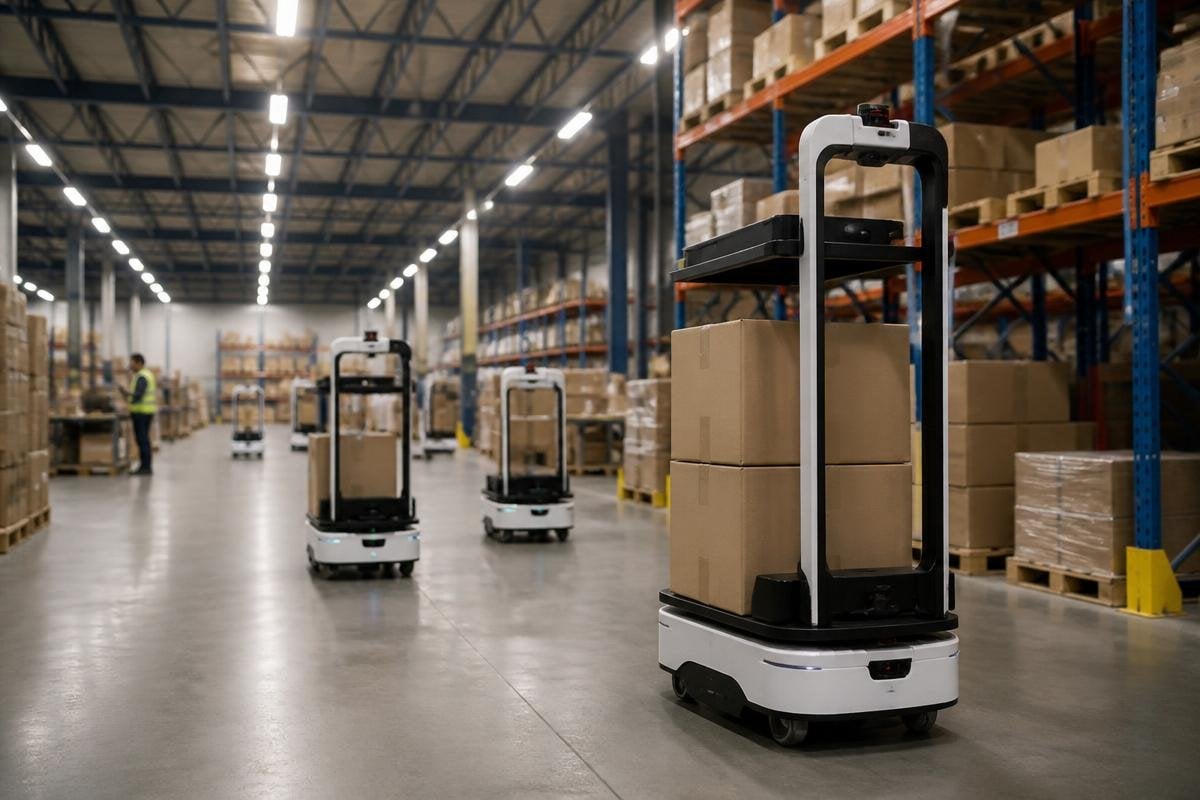
Millions of robots would change streets, warehouses, farms, and care work before most homes gained a robot helper. The harder question is who would own these machines, who would maintain them, and how people would share space with them.
- More machines would mean more charging, repair, and software work
- Jobs would change task by task, not vanish in one sweep
- Public rules would matter as much as robot hardware
The first change would be physical work
A large robot population would likely appear first in places with repeated tasks, controlled routes, and clear safety rules. Warehouses, ports, factories, farms, and recycling sites fit that pattern better than busy homes or crowded streets.
A robot that moves boxes can repeat the same route for hours. A farm machine can inspect rows or carry loads across known ground. Those jobs still need people to set goals, check faults, repair equipment, and handle work that falls outside the normal pattern.
That shift would change job design. One person might watch several machines, while another fixes grippers, wheels, batteries, sensors, or network links. The work would move closer to planning and repair, but access to that work would depend on training and local demand.
Cities would need new robot services
A population that large would need places to charge, update software, park, and receive repairs. A delivery robot returning to a depot is easy to picture; a city full of machines crossing sidewalks, loading bays, and road crossings is harder to manage.
The physical details would set the limits. Charging points would need enough electrical supply. Service sites would need spare parts and trained staff. Roads and buildings might need marked areas for loading, crossing, or temporary storage.
Noise and access would matter too. A sidewalk robot that blocks a wheelchair user creates a public problem even if its navigation system works as planned. A farm robot that loses a signal may stop safely, but it could still leave a load in the wrong place.
When millions of machines share streets, farms, and workplaces, a polished demo tells you very little. Reports on working robot deployments can tie a machine’s claim to a named site, task, date, and result. That record gives the next section a firmer question: which kinds of work change first?
Work would change before it disappeared
A machine can take over a task without taking over a whole job. Sorting, lifting, inspection, cleaning, and transport are made of smaller actions, and each action has its own safety and cost limit.
Some workers would spend less time on strain-heavy tasks. Others could face fewer hours if a company buys robots for work they used to do. The result would depend on local labor rules, ownership, training, and whether the machines add new work or replace paid shifts.
The money would also spread unevenly. Large companies could buy fleets and service contracts sooner than small firms.
A small operator might rent robot time from a service company instead of owning machines, while a rural business could face long waits for repair staff.
I’d expect the first major social argument to be about control, not whether robots look human. People will ask who can stop a machine, who pays when it causes damage, and which records its sensors keep.
Homes would change more slowly
A home robot has to deal with clutter, pets, children, stairs, fragile objects, and changing instructions. A factory floor can be marked and measured. A kitchen cannot stay in the same state for long.
That makes household robots harder to deploy in large numbers. They need safe contact with people, good error recovery, and a price that fits ordinary household budgets. A machine that needs a technician after every failed task won’t work as a daily helper.
Care work raises a separate concern. A robot might carry laundry, fetch objects, or remind someone about a routine. Physical help can reduce strain, but it cannot answer every need for company, judgment, or consent.
Use this test for any million-robot claim
Before accepting a prediction, check these points:
- Name the task the robot performs and the place where it runs.
- Find the power source, charging plan, and repair process.
- Ask who watches the machine when its normal routine fails.
- Check which person or company carries the cost of damage.
- Separate a working deployment from a short filmed demonstration.
- Look for the training, permits, and safety rules needed nearby.
A robot population in the millions would not create one uniform society. Machines would enter the places where repeatable work pays for them, then test whether power, labor rules, public space, and repair systems can keep up. The first proof would be simple: how many machines keep working after the cameras leave?
